Glyph Feature Showcase
This document demonstrates all the rendering features supported by Glyph. The YAML frontmatter at the top is rendered as the metadata block you see above this paragraph — title, author, date, and tags are recognised; other string keys appear in a small key/value list.
Contents
- Frontmatter
- GitHub Flavored Markdown
- Code Blocks
- Math / LaTeX
- Mermaid Diagrams
- D2 Diagrams
- CSV / TSV Tables
- Footnotes
- Emoji Shortcodes
- Bidirectional Text
- Blockquotes
- Raw HTML
- Images
- Links
- Jupyter Notebooks
- Canvas
- AI Assistant
- Keyboard Shortcuts
Frontmatter
Glyph reads YAML frontmatter at the top of a document and renders it as a heading block. Recognised keys:
| Key | Renders as |
|---|---|
title | Large gradient heading at the top |
author | Subtle line under the title with a person icon |
date | Same line as author, with a calendar icon (shown verbatim — no reformatting) |
tags | Chip-style pills, each in a deterministic colour derived from the tag name |
| anything else | Small uppercase key / value list at the bottom of the block |
Documents without frontmatter render as before — no extra spacing, no empty card.
GitHub Flavored Markdown
Tables
| Feature | Status | Priority |
|---|---|---|
| GFM tables | Done | High |
| Task lists | Done | High |
| Footnotes | Done | Medium |
| Strikethrough | Done | Medium |
Task Lists
- GitHub Flavored Markdown
- Syntax highlighting with copy button
- Math/LaTeX rendering
- Mermaid diagrams
- D2 diagrams
- Tabs and in-document search
- Presentation mode
Strikethrough & Autolinks
This text has strikethrough formatting. Visit https://github.com/hamidfzm/glyph for more info.
Code Blocks
Hover over a code block to see the copy button in the top-right corner.
function fibonacci(n: number): number {
  if (n <= 1) return n;
  return fibonacci(n - 1) + fibonacci(n - 2);
}

console.log(fibonacci(10)); // 55
def quicksort(arr):
    if len(arr) <= 1:
        return arr
    pivot = arr[len(arr) // 2]
    left = [x for x in arr if x < pivot]
    middle = [x for x in arr if x == pivot]
    right = [x for x in arr if x > pivot]
    return quicksort(left) + middle + quicksort(right)
fn main() {
    let greeting = "Hello, Glyph!";
    println!("{greeting}");
}
Math / LaTeX
Inline math: Einstein's famous equation changed physics forever.
Block equations:
Matrix notation:
Mermaid Diagrams
.mmd source files
.mmd is recognised as either a raw Mermaid diagram source or a
MultiMarkdown document. Glyph sniffs the first non-comment line: if it
starts with a Mermaid declaration (flowchart, graph, sequenceDiagram,
pie, mindmap, gantt, etc.), the file is wrapped in a
```mermaid fence and rendered as a diagram. Anything else is treated
as plain markdown.
Open Flowchart for the diagram variant and Notes/Cooking for the
MultiMarkdown variant; both files use the .mmd extension.
D2 Diagrams
Fenced code blocks tagged d2 render as D2 diagrams,
theme-aware like Mermaid. D2 is well suited to architecture diagrams with
nested containers and labelled connections. Click any rendered diagram (D2 or
Mermaid) to open it in the lightbox, where you can zoom in and drag to move
around the detail.
direction: right

reader: Reader
glyph: Glyph {
  parse: Parse Markdown
  render: Render View
  parse -> render
}
reader -> glyph.parse: opens a file
glyph.render -> reader: rendered output
.d2 source files
A .d2 file's whole body is diagram source. Glyph wraps it in a ```d2
fence and renders it directly, the same way .mmd files render as Mermaid.
.d2 files show up in the workspace file tree and open straight into the
diagram viewer.
Open Architecture for a full example using nested containers, a person and cylinder shape, and bidirectional connections.
CSV / TSV Tables
Fenced code blocks tagged csv or tsv render as styled, scrollable
tables instead of raw text. The first row is treated as the header.
Quoted fields with embedded commas, quotes, and newlines are supported.
Name,Role,Commits
Alice,Maintainer,1240
Bob,Contributor,87
"Carol, Jr.",Reviewer,312
Tab-separated values work the same way with a tsv fence:
Symbol	Price	Change
AAPL	189.50	+1.2%
GLPH	42.00	-0.4%
Malformed data falls back gracefully to the raw code block.
Footnotes
Glyph supports GitHub-style footnotes1. You can reference them multiple times2.
Footnotes can contain rich text and even code3.
Emoji Shortcodes
Glyph converts GitHub-style emoji shortcodes to Unicode:
👋 Hello! 🚀 Ship it! 🎉 Celebration! 🐛 Found a bug ✅ Tests passing ❤️ Love it 👍 Approved
Bidirectional Text
Each paragraph resolves its own direction from its first strong character, so RTL and LTR text mix freely in one document.
این بند به فارسی نوشته شده و از راست به چپ نمایش داده میشود، حتی وقتی بقیه سند انگلیسی است.
هذه الفقرة مكتوبة بالعربية وتعرض من اليمين إلى اليسار.
Mixed inline text works too: the word سلام means "hello" in Persian, and code like let x = 1 stays left-to-right even inside an RTL paragraph.
- فهرستها هم پشتیبانی میشوند
- Bullet items keep their own direction per line
نقلقولها نیز جهت خود را از متن میگیرند.
Blockquotes
"The best way to predict the future is to invent it." — Alan Kay
GitHub Alerts
NOTE
Useful information that users should know, even when skimming content.
TIP
Helpful advice for doing things better or more easily.
IMPORTANT
Key information users need to know to achieve their goal.
WARNING
Urgent info that needs immediate user attention to avoid problems.
CAUTION
Advises about risks or negative outcomes of certain actions.
Raw HTML
Glyph allows a curated subset of inline HTML — the elements GitHub renders inside READMEs.
Subscript: H2O. Superscript: E = mc2.
Press Cmd+K to open the command palette.
Click to expand
Hidden content lives inside <details> blocks. Useful for FAQs, troubleshooting steps, and changelog entries.
Centered paragraphs work too.
Images
Remote Images

Local Images
Relative paths resolve against this file's folder, so SVGs and other images committed next to your notes render inline:
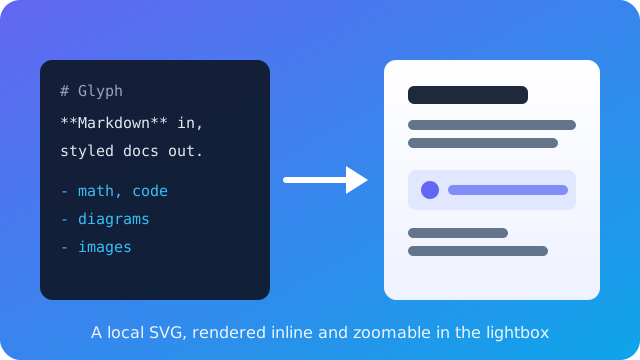
Click any image to open it in the lightbox: zoom in/out, fit or actual size, drag to pan around a zoomed-in image, and use the arrow keys to move between them. Press Esc or click the backdrop to close.
The workspace also ships standalone image files in several formats. Open diagram.png, diagram.jpg, diagram.gif, or diagram.svg from the file tree: each opens in the image viewer, where the same controls (zoom in/out, fit, actual size, scroll or drag to pan) apply. SVGs render crisply at any zoom.
Inline SVG
You can also embed SVG straight into the markdown. It renders inline from a sanitised allowlist (shapes, gradients, and text — no scripts or external references), which is handy for small, theme-friendly diagrams:
Links
- Glyph on GitHub — External links open in your system browser
- Go to Code Blocks — Anchor links navigate within the document
Wikilinks
When you open a folder as a workspace, [[note]] style links resolve to other markdown files inside it. Open the samples/ folder (Cmd/Ctrl+Shift+O) to make these resolve:
- Index — links to
Index.mdin this workspace - kitchen notes — display custom text, link to
Notes/Cooking.md - Index — link to a heading inside another note
- Missing — broken link, renders muted (no target in workspace)
- Cooking
Opening this file on its own (no folder) treats every wikilink as broken.
Note embeds
Prefix a wikilink with ! to render its target inline instead of linking to
it. With the samples/ folder open, these expand in place:
Each embed sits in a bordered block; hover it for a control that opens the
source note. ![[note#heading]] embeds only that section. A missing target or
heading shows a placeholder, and a note that embeds itself (directly or through
a chain) shows a circular-embed placeholder instead of looping.
Relative links
Standard markdown links with relative paths resolve against this document's
folder and open in the workspace, including paths that walk up with ../. With
the samples/ folder open, these all open in-app:
- the index — a sibling markdown file
- kitchen notes — a file in a subfolder
- the canvas demo — opens as a canvas board
Relative image paths resolve the same way. This SVG sits in a sibling folder:
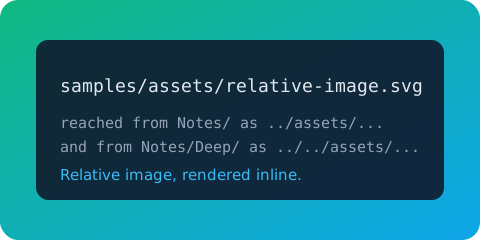
../ and ../../ are best seen from a nested note, where they have somewhere
to climb to:
- Notes/Relative-Links — one level deep; uses
../to reach the root - Notes/Deep/Deeper-Relative-Links — two levels deep; uses
../../
Targets that resolve outside the open folder are refused. From this root
README, ../ already points above samples/, so links like
[escape](../outside.md) and images like  are not
followed and render nothing. Opening any of these files on its own (no folder)
leaves every relative link to the browser instead.
Backlinks
When you have the samples/ folder open, the Backlinks section under the file tree lists every other note that links to the current document. This file is referenced from Index and Notes/Cooking, so opening either of them will show this file in their backlinks panel.
Graph view
With the samples/ folder open, press Cmd/Ctrl+G (or View → Open Graph) to see this workspace as a graph: every note is a node, every wikilink an edge. Hover a node to highlight its neighbours, click one to open that note, drag to pan, and scroll to zoom. Missing targets never appear (broken links are dropped), and notes nothing links to render muted.
This workspace is wired to make the graph worth a look: Index and Graph View act as hubs, the cooking notes (Notes/Cooking, Ingredients, Techniques) form a tight cluster, and Scratchpad sits off on its own as a muted orphan. The Graph View note is a full walkthrough of the feature.
Export as a website
With the samples/ folder open, File → Export → Website… turns this whole workspace into a static site: every note becomes a linked HTML page (the root index.md, or else this README, becomes index.html), wikilinks and relative links navigate between pages, images are copied alongside, Mermaid diagrams render as inline SVG, and a navigation sidebar ties it together. The same export runs headless from the terminal for CI publishing:
glyph samples/ --export-website ./site
Wikilink autocomplete
In the editor or split view, typing [[ opens a popup with workspace files. Keep typing to filter, press Tab or Enter to insert; the closing ]] is added for you. Open this file in split view (Cmd+E cycles modes) and try typing [[Co to see it.
Jupyter Notebooks
Glyph opens .ipynb files directly — no Jupyter required. Open Notebook.ipynb from the file tree (or run glyph samples/Notebook.ipynb) to see it. Notebooks are read-only and render each cell in order:
- Markdown cells get the full markdown pipeline above — math, code, Mermaid, alerts, the lot.
- Code cells are syntax-highlighted using the notebook's kernel language, with an
In [n]:prompt in the gutter. - Outputs render under their cell by richest type: images (
image/png,image/jpeg,image/svg+xml), sanitised HTML, markdown, and plain text. Stream output and exception tracebacks keep their ANSI colours instead of showing raw escape codes. AnOut [n]:prompt marks execution results.
Interactive outputs (Plotly, Vega, Jupyter widgets) aren't rendered yet — they show a short placeholder. Notebooks can't be edited in Glyph, so the mode toggle stays read-only: view shows the rendered cells, edit shows the raw .ipynb JSON as a syntax-highlighted source view, and split shows the JSON source and rendered cells side by side.
Canvas
Glyph opens JSON Canvas (.canvas) files as an infinite, pan-and-zoom board. Open canvas-demo.canvas from the file tree (or run glyph samples/canvas-demo.canvas) to see it.
- Cards render markdown text, embedded images, links, and labelled groups.
- Connections are drawn as arrows between card sides, with optional labels.
- Navigate by scrolling to pan and
Cmd/Ctrl+scroll (or pinch) to zoom; the toolbar has zoom and fit-to-content controls.
The mode toggle switches between reading and editing (split is hidden for canvas — the board itself is the editor):
- View is the read-only board.
- Edit is the full editor — drag to move cards, drag the corner handle to resize, drag a side connector to draw an edge, double-click a card to edit its markdown (or a link's URL, or a group's label) inline, and double-click a connection to label it. Use the selection toolbar to recolour (six presets or any custom colour) or delete. Dragging a group carries every card inside it, so groups work as movable regions, not just backdrops. Double-click empty board space to drop a new card right there, or use the
+ Card/+ Group/+ Linktoolbar buttons;Delete/Backspaceremoves the selection. Right-click works everywhere: empty space offers New card / New group / New link at the cursor, a card offers edit, colour, and delete, and a connection offers label editing and delete. Edits save as standard.canvasJSON (interoperable with Obsidian) and undo/redo withCmd/Ctrl+Z/Cmd/Ctrl+Shift+Z.
Canvas boards integrate with the rest of the app: File → Export saves the board as a vector HTML page or a board-sized vector PDF that mirror the spatial layout, or linearises the cards into a Word or EPUB document; task-list checkboxes on cards are clickable in both view and edit mode, the status bar word count (and AI / read-aloud) reads the board's cards rather than its JSON, and canvases sync and back up like any other workspace file.
Create a fresh board from the file tree: right-click a folder (or the empty panel) and choose New Canvas.
AI Assistant
Glyph ships an AI chat that converses about the open document with streaming replies, docked beside the text. Configure a provider in Settings → AI (a local Ollama server needs no API key; Claude and OpenAI take yours), then open the chat with the sparkle button in the tab bar or Cmd+Shift+A.
- Quick actions — Summarize / Explain / Translate / Simplify the document from the chips, the AI menu, or the right-click menu (select text first to run them on just the selection).
- Locate quotes — when the assistant quotes the document, click Show in document to scroll to and flash the passage.
- Read aloud — hover an assistant reply for Copy and Read Aloud.
Open AI Playground for a guided set of prompts to try against prepared content: a story to question, a table to interrogate, code to explain, and a Persian paragraph for right-to-left answers.
Keyboard Shortcuts
| Shortcut | Action |
|---|---|
Cmd+O | Open file(s) |
Cmd+Shift+O | Open folder |
Cmd+K | Command palette |
Cmd+G | Workspace graph |
Cmd+P | Print / Export to PDF |
Cmd+F | Find in document |
Cmd+= / Cmd+- | Zoom in / out |
Cmd+0 | Reset zoom |
Cmd+Z / Cmd+Shift+Z | Undo / redo task checkbox toggles |
Cmd+Shift+PageUp / Cmd+Shift+PageDown | Move tab left / right |
Cmd+B | Toggle sidebar |
Cmd+Shift+A | AI chat |
Cmd+, | Settings |
Try pressing Cmd+F to search this document, or Cmd+P to print / save as PDF. Use File → Export to save this page as HTML, Word (DOCX), EPUB, or PDF — math, code highlighting, tables, and images are carried straight from the rendered view.